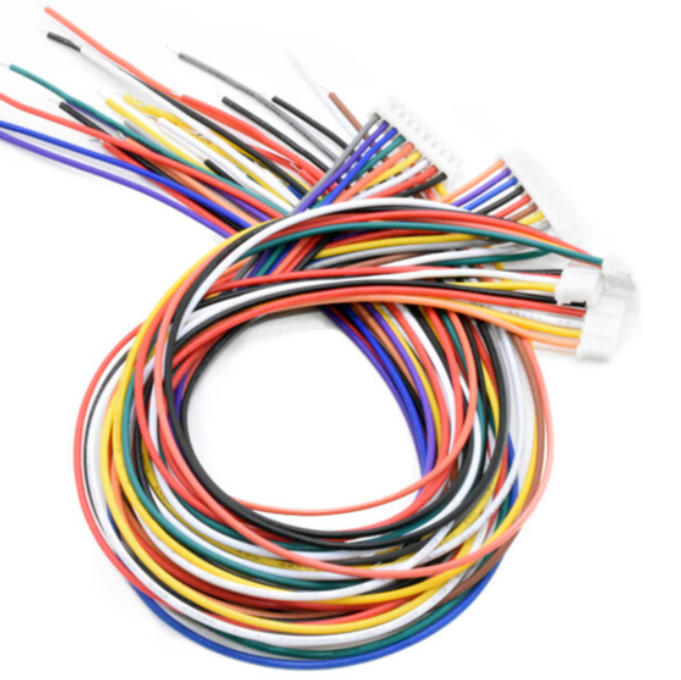
There are many specifications for cooling fans, but the number of wires in a cooling fan is usually limited to 2, 3, 4, 5, or 7 wires.
What color are the fan wiring harnesses usually?
Although there are no explicit regulations, the colors of fan wiring harnesses are very standardized, generally only red, black, yellow, white, blue, green, pink, brown, and purple.
What are the functions of the fan's wiring harness connections?
| Wire | Function | Application |
|---|---|---|
| 2 wire | power supply | meets the basic operating functions of the fan |
| 3 wire | power supply + speed measurement | providing feedback on the fan speed through signals that report the fan's rotational status. |
| 4 wire | power supply + speed measurement + speed control | intelligent temperature control/PWM control, intelligently adjusts fan speed based on temperature. |
| 5wire | power supply + speed measurement + speed control + alarm | monitoring + alarm functions, with the ability to control the speed and provide early warning for abnormal equipment cooling. |
| 7wire | power supply + speed measurement + speed control + alarm + multi-signal expansion | industrial control, typically customized signal feedback and control functions based on the needs of industrial equipment. |
Line Color Introduction
| Color | Function |
|---|---|
| Red | Power(3V/5V/12V/24V/48V~600V) |
| Black | GND |
| Yellow/White | FG |
| Blue/Green | PWM |
| Other | Other signals |
Of course, please note that the above color chart is only an industry convention; the final reference must be the fan specification sheet. Especially for industrial fans and thin fans dedicated to graphics cards, the wiring sequence may be customized, and blindly connecting based on color could risk damaging the board.
About PWM ,Click https://ldindustry.cn/case/pwm-technology
Finally, to summarize:
1. 2-wire fan (Power+GND)
Core function: Constant speed rotation without any feedback or speed regulation function.
Application Scenario:
Low end/low-cost devices: such as old-fashioned chassis fans, inexpensive CPU heat sinks, set-top boxes, routers.
Always rotating heat dissipation area: such as inside some power supplies, simple industrial control chassis side panels (without speed regulation).
Features: The structure is the simplest, does not support speed regulation, and has a constant speed.
2. 3-wire fan (Power+GND+FG)
Core function: Constant speed+speed feedback (speed measurement). Added FG (Frequency Generator) signal line on the basis of 2-line.
Application Scenario:
Industrial equipment that requires speed monitoring, such as server power supplies, professional industrial computers, and high-end network devices.
Desktop motherboard: Early CPU fan interface (now mostly 4-wire).
Feature: The motherboard can read the speed, but cannot adjust the speed.
3. 4-wire fan (Power+GND+FG+PWM)
Core function: Intelligent temperature control and speed regulation+speed feedback. Added PWM (Pulse Width Modulation) signal line.
Application Scenario:
The vast majority of modern computer hardware includes desktop CPU fans, graphics card fans, and mainstream chassis fans.
Devices that require mute control, such as NAS and game consoles.
Features: The motherboard sends a duty cycle signal (0-100%) based on temperature to control the speed, with low temperature low speed silent and high temperature high speed heat dissipation. This is currently the most mainstream specification.
4. 5-wire fan (Power+GND+FG+PWM+TACH/Alert)
Core function: Intelligent speed regulation+dual signal monitoring. Added alarm signals on the basis of 4-wire.
Application Scenario:
Server/Workstation: Requires extremely high reliability. Once the fan stops running or malfunctions, the system will immediately sound an alarm (red light/buzzer).
Industrial grade precision equipment: such as precision instruments and medical equipment.
Features: In addition to speed regulation, it can also monitor the health status of the fan in real time and support fault shutdown alarms.
5. 7-wire fan (multi signal line extension)
Core function: Advanced control and feedback. Usually specialized for industrial grade or specific high-end equipment, it integrates more control logic.
Application Scenario:
Industrial automation equipment: PLC control cabinet, large frequency converter, robot cooling system.
Special customized server: It is necessary to support multiple speed feedback, multiple PWM control, or forward and reverse control scenarios simultaneously.
Features: Line sequence definition is usually vendor specific, supports complex bus control or multi-dimensional state monitoring, has extremely narrow compatibility, and is mostly used in professional fields.